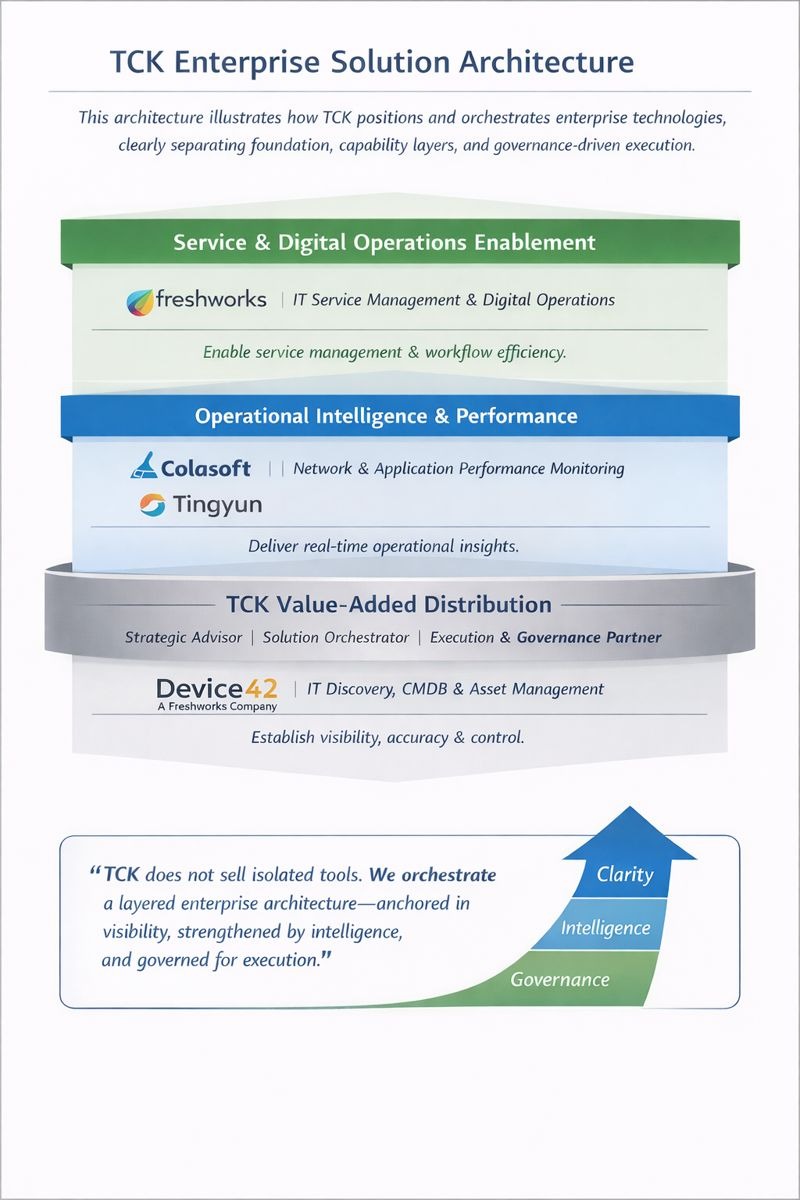
TCK Enterprise Solution Architecture
This architecture illustrates how TCK positions and orchestrates enterprise technologies, clearly separating foundation, capability layers, and governance-driven execution.
Layered Architecture Diagram (Narrative Form)
Layer 1 – Foundational Visibility (Core Layer)
IT Infrastructure Discovery – Dependency Mapping – Configuration Management Database(CMDB) – IT Asset Management (ITAM) – Data Center Infrastructure Management (DCIM)
Provide a trusted, unified view of the enterprise IT environment. This layer establishes visibility, accuracy, and control, forming the decision foundation for all downstream initiatives.
Layer 2 – Operational Intelligence & Performance (Capability Layers)
Network Performance Monitoring & Diagnostics (NPMD)
Application Performance & Digital Experience Monitoring
Deliver real-time operational insight and performance intelligence on top of a trusted infrastructure foundation.
Layer 3 – Service & Digital Operations Enablement (Business Operations Layer)
IT Service Management (ITSM) – Digital Operations & Service Enablement
Enable service management, workflow efficiency, and operational governance
aligned with business outcomes.
Cross-Layer Role – TCK Value-Added Distribution
TCK acts across all layers as: – Strategic Advisor – Solution Orchestrator – Execution & Governance Partner
Responsibilities: – Ensure architectural alignment – Maintain principal independence – Translate technology into outcomes – Govern execution quality and accountability
Key Message for Board & CXO
“TCK does not sell isolated tools. We orchestrate a layered enterprise architecture—anchored in visibility, strengthened by intelligence, and governed for execution.”
This model reinforces TCK’s positioning as a market-leading Value-Added Distributor, focused on clarity, accountability, and enterprise-scale outcomes.